Organizations for multi-store entrepreneurs
Unlocking new value for an underserved merchant segment
Background
With different platforms for different plans, Shopify struggled to effectively meet merchant needs. Mid-sized merchants couldn't centrally manage stores and staff, enterprise merchants faced performance issues, and separate codebases created internal inefficiency.
As design manager, I partnered with product engineering and data science to lead a strategic pivot that reframed the problem and secured company-wide buy-in. My team shipped Organizations, a new platform architecture purpose-built for multi-store. Over 1 year, I coached 4 designers across 7 teams to align on a shared navigation model spanning store login, organization settings, and the store switcher, turning fragmentation into a unified foundation.
01 Strategy
Redefine the merchant audience, map the future of multi-store, and sell the vision across teams
02 Design decisions
Prioritize merchant choice, clarity, and flow
03 Impact
Scalable infrastructure and broader thinking
Outcomes
21% GMV
User segment unlocked
200k+
Lines of code removed
100%
Users migrated, with 1% uptick in support tickets
01 Strategy
Redefine the merchant audience, map the future of multi-store, and sell the vision across teams
I reframed the merchant story from migration to growth enablement.
Using insights from usability testing and data science, I reframed the work as unlocking Shopify's second-largest merchant segment: multi-store entrepreneurs (21% GMV). We weren't just migrating merchants to one platform—we were supercharging an overlooked yet high-value segment.
I aligned 7 product teams on the new organization model.
I created visual models (like the one below) to align stakeholders on entity relationships, system impact, and boundaries. This helped teams understand how stores, dashboards, and features fit into the future infrastructure and how merchants would navigate them.
I championed a flexible architecture that scaled with business complexity.
My team pushed for new navigation and settings that protected usability for single-store merchants and elevated functionality for multi-store businesses.
02 Design decisions
Prioritize merchant choice, clarity, and flow
Choice → Letting merchants decide when/how they grow
Introducing organization settings risked overwhelming merchants who didn't need them yet. I led the strategy for an opt-in model, partnering with leadership to define the right timing and visibility, so the interface scaled with complexity rather than imposing it.
Clarity → Defining concepts for cross-surface consistency
Without shared language, teams struggled to build for new paradigms. I created a reference glossary to explain organizations, legal entities, and stores to ground UX decisions.
Flow → Making cross-surface navigation seamless
My team considered every persona (admin, staff, developer) and entry point, so users could access tools intuitively, without needing to understand the architecture beneath.
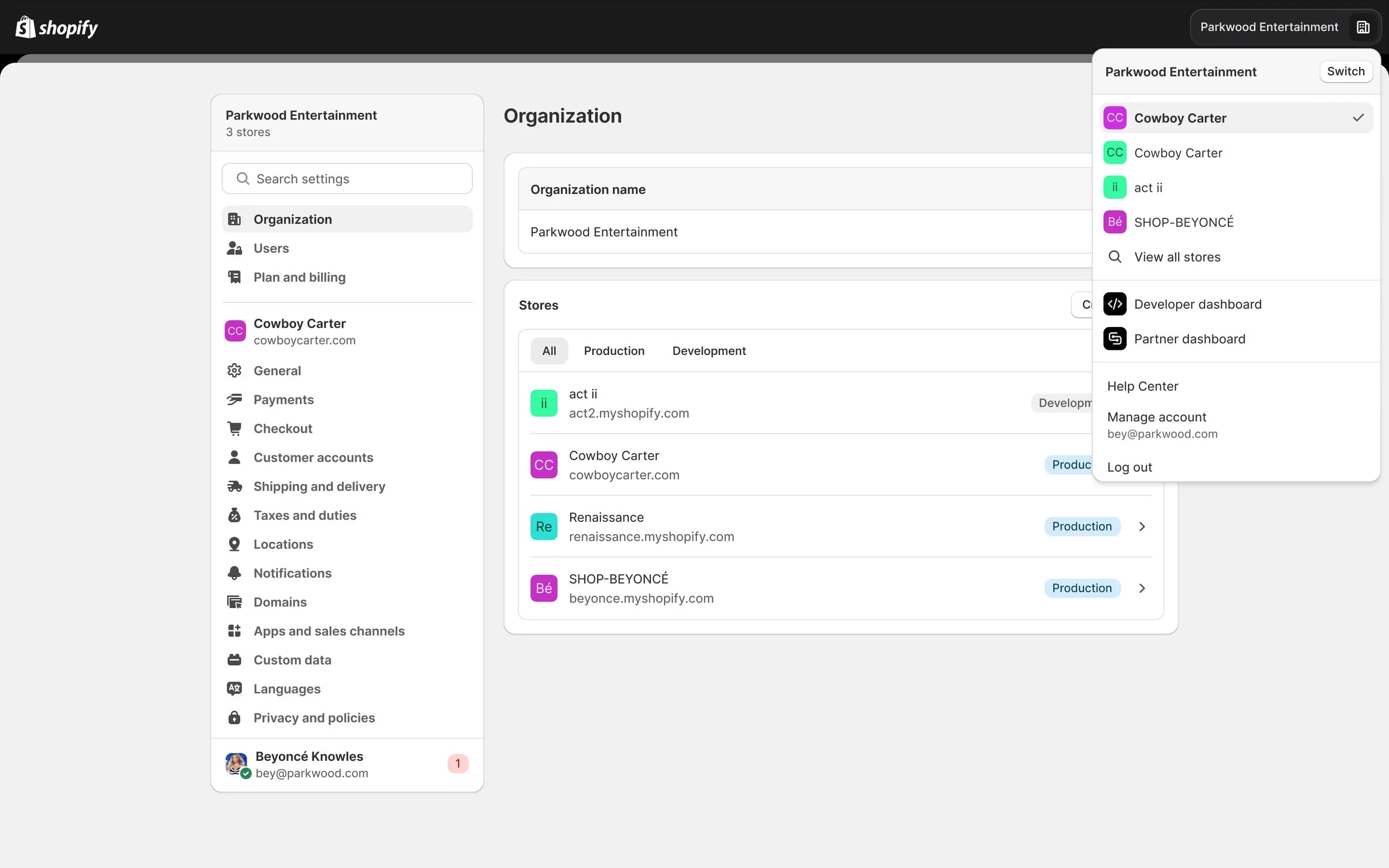
🙋🏻♀️ Ask me to demo the full shipped experience
03 Impact
Scalable infrastructure and broader thinking
This work shifted how Shopify thinks about merchants: not as "small" or "enterprise," but as scaling businesses expanding across stores, brands, and regions. The foundation has already extended beyond its original scope: other product groups have elevated offerings like payments and feature previews to the organization level, and my team is designing a standalone entry point for organization settings, enabling staff to manage operations without needing store-level access.